For many patients with Lyme disease, the hardest part of getting better is getting a clear answer. Symptoms can be confusing, early tests can miss infections, and the current recommended testing process often requires multiple steps before patients and doctors have the information they need.
For UCLA undergraduate researcher Olivia Goodreau, this challenge is personal. Olivia is a Lyme disease patient and the founder of the LivLyme Foundation, an organization dedicated to increasing awareness, funding research, and improving care for Lyme disease patients. Through undergraduate research opportunities at the NSF Precise Advanced Technologies and Health Systems for Under-resourced Populations Engineering Research Center (PATHS-UP), Olivia and many other young engineers and scholars received hands-on research training working on cutting-edge diagnostic technologies. Based on PATHS-UP’s novel vertical flow assay platform, these students and their faculty mentors are advancing the research to new applications and, in this case, to make Lyme disease testing faster, simpler, and more accessible.
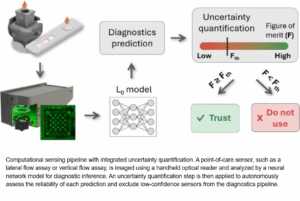
The researchers developed this PATHS-UP technology toward a new single-test approach for Lyme disease diagnosis. Instead of relying on the traditional two-step testing process, this new test is designed to detect multiple Lyme disease markers at once from a single sample. In a 2024 Nature Communications publication, the test showed highly promising performance, including 95.5% sensitivity and 100% specificity in blinded validation studies, and strong agreement with standard laboratory testing using CDC Lyme disease reference samples.
The impact of this work extends beyond the laboratory. Olivia was recently invited to bring her perspective as both a patient advocate and student researcher to an HHS-convened Lyme Disease Summit hosted by Robert F. Kennedy, Jr., where she spoke about the urgent need for better Lyme disease diagnostics and highlighted the promise of this new test. Her story reflects what NSF Engineering Research Centers are uniquely positioned to do: connect fundamental engineering advances with real people and real health challenges, and train the next generation of engineers, scientists, innovators, and entrepreneurs.
The technology is also attracting commercial interest from Lyme disease test manufacturers, suggesting a potential path to real-world use. If successfully developed and adopted, this single-test approach could help patients receive answers sooner, support earlier treatment, and reduce the uncertainty that too many families face during the search for a Lyme disease diagnosis.
The NSF ERC support helped create the environment where students with lived experience, a team of engineers and scientists, and a national health challenge could come together around a shared goal: turning advanced diagnostic science into tools that can improve lives.
One-sentence impact statement
NSF support helped advance a single-test Lyme disease diagnostic that could give patients faster answers, support earlier treatment, and demonstrate how federally funded research and hands-on training opportunities for young scholars can translate innovations into real-world health benefits.